Purifier, Humidifier, or Both? Getting a Bedroom's Air Right
Dry air and dirty air cause different problems and need different fixes. How to tell which one your room has, and what actually helps a nursery or bedroom.
Two devices get recommended for the same room for opposite reasons. A purifier removes particles from the air. A humidifier adds water to it. Buy the wrong one and you will spend a hundred dollars solving a problem you did not have, while the real problem continues.
The first step is figuring out which problem you actually have, and that is easier than it sounds.
Dry air and dirty air feel different
Dry air shows up as a scratchy throat in the morning, cracked lips, static, dry skin, worsening nosebleeds, and a nose that feels congested without being sick. In winter, heated indoor air can drop below 30 percent relative humidity, which is drier than most deserts.
Dirty air shows up as sneezing fits, itchy eyes, a cough that appears when you enter a room, dust visible on dark surfaces within a day of cleaning, and symptoms that worsen when the heating or AC kicks on. If someone in the house has allergies or asthma, particle load matters more than humidity.
You can check the humidity side for very little money with a hygrometer, a small digital reader that costs less than lunch. Most homes sit comfortably between 30 and 50 percent. Below 30 percent and a humidifier earns its place. Above 50 to 60 percent, adding moisture is counterproductive: high humidity encourages dust mites and mold, which are themselves particle problems.
What a purifier actually does
A HEPA filter is rated to capture 99.97 percent of particles at 0.3 microns. That covers dust, pollen, pet dander, smoke particles, and much of what dust mites leave airborne. It does not remove gases or odors, which need carbon, and it does not kill anything.
The two things that determine whether a purifier helps are filter quality and airflow. A great filter in a weak unit cleans a small circle around itself. Match the unit's rated room size to your actual room, and run it continuously rather than in bursts, because particle levels rebuild the moment it stops.
Placement matters too. Put it where you spend the most hours, usually the bedroom, and give it a little clearance from the wall so it can actually move air.
What a humidifier actually does
A humidifier raises relative humidity, which helps dry nasal passages, dry throat, and the general misery of heated winter air. It is not a treatment for illness, but a nose that is not dried out does its job of filtering and warming air more comfortably.
The catch is maintenance. Standing water in a warm machine is an excellent place for biofilm. A humidifier that is not cleaned weekly can spray more particles into the room than a purifier removes. That single fact is the reason many pediatricians are cautious about recommending them.
If you use one: empty and dry it daily, clean it weekly, use distilled water if you have hard water, and keep the room's humidity in the 30 to 50 percent range rather than chasing a number higher than that.
Why a combined unit makes practical sense
Most people do not want two machines, two power adapters, two filters, and two reasons to crawl under a crib. A combined unit handles both jobs in the footprint of one device.
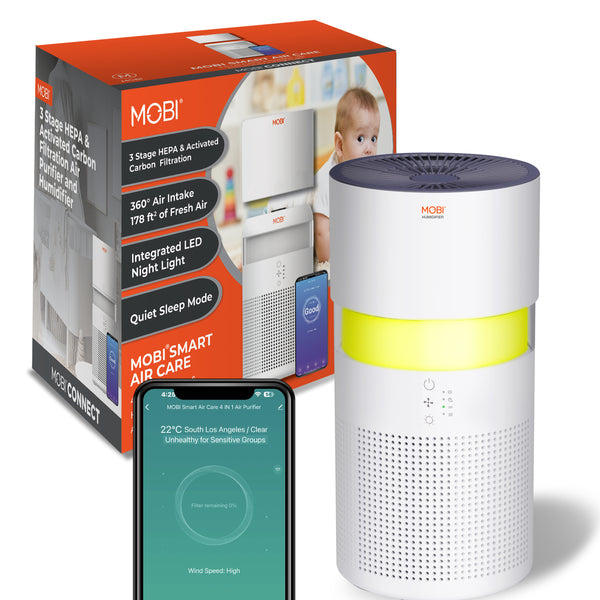
The MOBI 4-in-1 Air Care combines a HEPA purifier, a humidifier, an aromatherapy diffuser, and a nightlight, with Wi-Fi control and air quality feedback from the MOBI app. That last part is more useful than it sounds: a sensor that reports when particles rise tells you whether the purifier is winning, instead of leaving you to guess based on how the room smells.
The nightlight is not decoration either. A soft, adjustable glow at the level of the floor is what makes a 3 a.m. feed possible without turning on an overhead light that resets everyone's night.
What to be careful about with aromatherapy
Adding essential oils to a diffuser is the one function on a combined unit that deserves a warning. Strong fragrances are a known irritant for some people, and for infants and small children, pediatric guidance is generally cautious about essential oil exposure.
If you use the aromatherapy function, use it in an adult room, or in a nursery only after checking with your pediatrician and only at low concentration. The purifier and humidifier functions are the ones with clear everyday value.
A realistic setup for a nursery or bedroom
- Measure the room and check the purifier's rated coverage against it.
- Start with the purifier on low, continuously, rather than off and on.
- Check humidity with a cheap hygrometer before adding moisture.
- Keep the room between 30 and 50 percent relative humidity.
- Clean or replace the filter on the schedule the manual gives, not when it looks bad.
- Keep the unit a foot or two from the wall and away from curtains.
- If you use the diffuser, keep it away from the crib and check with your pediatrician first.
The honest summary
If your problem is dust, pollen, pets, or smoke, you need filtration. If your problem is a dry nose in February, you need humidity. If you have both, or you are setting up one room for a baby and do not want to guess, a combined unit with a sensor is the simpler purchase, provided you keep it clean and change the filter.
This article is general information, not medical advice. For allergies, asthma, or ongoing respiratory symptoms, talk to a clinician about what belongs in your treatment plan.
Devices mentioned in this article
Keep reading
Wrist vs. Upper Arm Blood Pressure Monitors: An Honest Comparison
A wrist cuff is easier to put on and an arm cuff is easier to trust. Here is how the two differ in real use, how to take a reading that counts, and who should pick which.
Read articleWhat Your Pulse Oximeter Reading Actually Means
A pulse oximeter gives you two numbers in eight seconds. Here is what SpO2 and pulse rate can tell you, what they cannot, and the three things that make a reading wrong.
Read articleEar vs. Forehead Thermometers: Which Reading Should You Trust?
Both take a temperature in a second. They do not measure the same place. A practical guide to picking a method by age, situation and time of night.
Read articleComparing models? See the full MOBI catalog side by side.
Compare products