Ear vs. Forehead Thermometers: Which Reading Should You Trust?
Both take a temperature in a second. They do not measure the same place. A practical guide to picking a method by age, situation and time of night.
Nobody enjoys taking a temperature. Someone is uncomfortable, possibly crying, possibly asleep, and you are holding a small device that needs to land in exactly the right spot. The question people ask us most often is not which brand to buy. It is which method is actually accurate, because the two numbers from an ear and a forehead on the same child can differ by a degree and a half.
Both readings can be correct. They are measuring different places, and the numbers are not interchangeable.
What each method is actually measuring
An ear thermometer reads the infrared heat coming off the eardrum and the tissue around it. Because the eardrum sits deep inside the head and shares blood supply with the hypothalamus, the part of the brain that regulates temperature, an ear reading is generally considered a good proxy for core body temperature. It is the method most pediatric offices reach for once a child is past the newborn stage.
A forehead thermometer reads the skin over the temporal artery, which runs across the side of the forehead. Skin surface temperature responds faster to the room, to a hat, to a flushed cheek from crying, and to sweat. A forehead reading is quick, non-invasive, and comfortable, but it is a surface reading rather than a core one.
That is the trade-off in one sentence: the ear gets closer to the core, and the forehead is gentler and easier to repeat.
The age rules that actually matter
For newborns under about three months, no consumer infrared thermometer is the right tool for a first fever. A rectal reading is what clinicians want at that age, and a fever in an infant that young is a call-the-doctor situation regardless of the number on the screen.
From roughly six months onward, ear and forehead readings both become practical. Ear thermometers need a canal that is large enough and straight enough for the probe, which is why they are less reliable in very small babies and in toddlers with a lot of earwax.
If your child has an ear infection, an ear injury, or has just come in from the cold, use the forehead instead. A congested or inflamed ear canal is not a neutral measuring site.
The forehead technique most people skip
A forehead thermometer is easy to use badly. The probe needs bare skin, no hair, no hat, and no sweat. If a child has been crying, their forehead will read warm for several minutes afterward. If they just came inside from a chilly walk, it will read cool.
For contact forehead models, rest the probe flat between the eyebrows and hairline and let it settle for the second it asks for. For no-touch models, hold the device at the distance the manual specifies, usually one to three centimeters, because distance changes the reading.
Take the reading twice. If the two numbers are close, you have a usable temperature. If they are far apart, something about the setup is off: hair in the way, a moving child, or a probe too far from the skin.
The ear technique most people also skip
Ear readings fail for one reason above all others: the canal is not straight. In an adult, pull the ear gently up and back. In a child over a year, pull it back. In an infant under a year, pull it gently back and down. Then seat the probe snugly enough to close off the canal, because outside air changes the reading.
Use a fresh probe cover if your model uses them, and check that the lens is clean. A smudge on the sensor is a silent source of wrong numbers.
For a wriggling child, the trick is speed and a second pair of hands: one person holds, one person takes the reading. It is not a moral failing to need help.
Why two thermometers in one device is more useful than it sounds
Dual-mode thermometers exist because the right method changes with the situation, not because the manufacturer could not decide.
At 2 a.m., with a sleeping toddler, a forehead reading is the one that does not wake anybody. Two hours later, when you want your most reliable number before deciding whether to call the pediatrician, the ear mode gives you the reading a nurse would take. Having both in one housing means you do not have to own two devices or hunt for the one you own.
The DualScan Prime is built exactly around that: forehead and ear in one compact body, about a second per reading, a color-coded backlit display so you can read it in a dark room without turning on a light, memory recall for the last reading, and a fever alarm.
When you want the number spoken out loud
There is a category of user that product listings rarely mention: people who cannot easily read a small screen in the dark, including older adults and anyone with low vision. For them, a thermometer that announces the temperature is not a gimmick.
The DualScan Ultra Pulse speaks the reading aloud and adds a built-in fingertip pulse rate sensor, which gives you two vitals in one device during a sick night. It also has a large backlit display and a color fever indicator for anyone who prefers to read it.
When you want the reading in an app
Fever is not one number, it is a shape over time. The useful question at a pediatric appointment is rarely "what was it at 4 p.m.?" but "how has it moved since yesterday?"
Bluetooth models answer that by logging every reading. The DualScan Bluetooth thermometer records ear and forehead readings, keeps separate profiles for each family member, and can hold medication reminders so the next dose does not get lost in a long night. There is a baby-specific version of the same device with a softer tip sized for smaller ears.
For households where one person manages care for a parent remotely, that history is the difference between a phone call that starts with "I think it was about 101" and one that starts with a chart.
No-touch models, and where they fit
A no-touch infrared thermometer reads the forehead from a short distance without contact. The appeal is hygiene: you can check a sleeping child, a visitor, or several family members in a row without cleaning the probe between each one. The MOBI Air version also switches to object mode, so the same device reads bath water, a bottle, or a room surface.
The trade-off is the same as any forehead method, only slightly more so: distance and drafts matter. Use it as a fast screening tool and a comfort-first option, not as your most precise measurement.
A few practical notes that apply to all of them
- Take the temperature before medication if you want a true baseline, and note the time.
- Fever numbers mean more when you also note how the person looks and behaves.
- Clean the probe between users. It takes five seconds and it is the whole reason these devices are safe to share.
- Replace batteries at the start of flu season rather than mid-fever.
- Write down the time, the method, and the number. Method matters, because an ear reading and a forehead reading are not the same scale.
The honest summary
If you want one device and one method, an ear thermometer past infancy gives you the reading closest to what a clinic would take. If you want the reading that actually happens at 3 a.m. without a fight, a forehead or no-touch model wins on usability. If you are choosing for a family with children of different ages, a dual-mode thermometer removes the guesswork entirely.
This article is general information, not medical advice. For an infant under three months with a fever, or anyone with a fever and concerning symptoms, contact a clinician.
Devices mentioned in this article
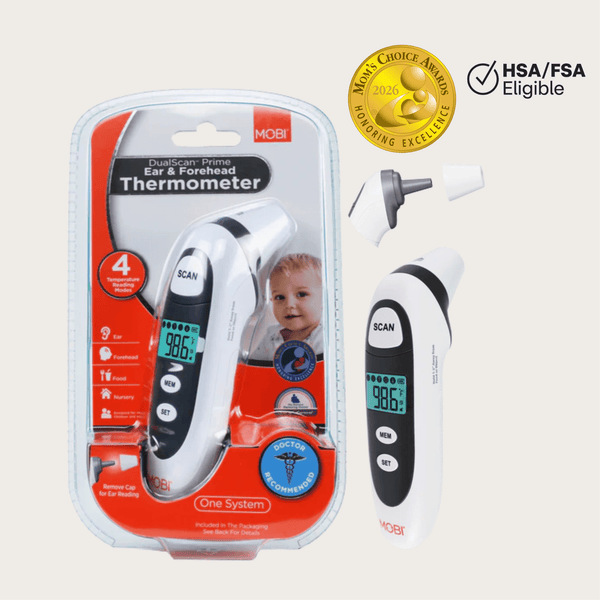
DualScan Prime Digital Forehead & Ear Thermometer
$19.99
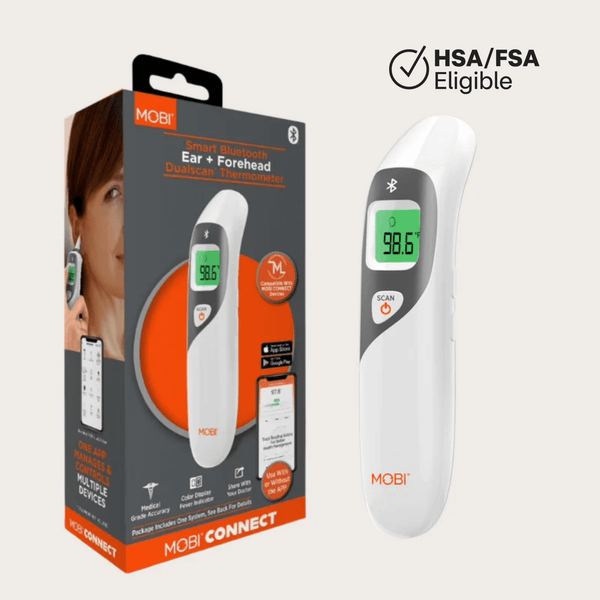
DualScan Ear & Forehead Bluetooth Digital Thermometer
$49.99
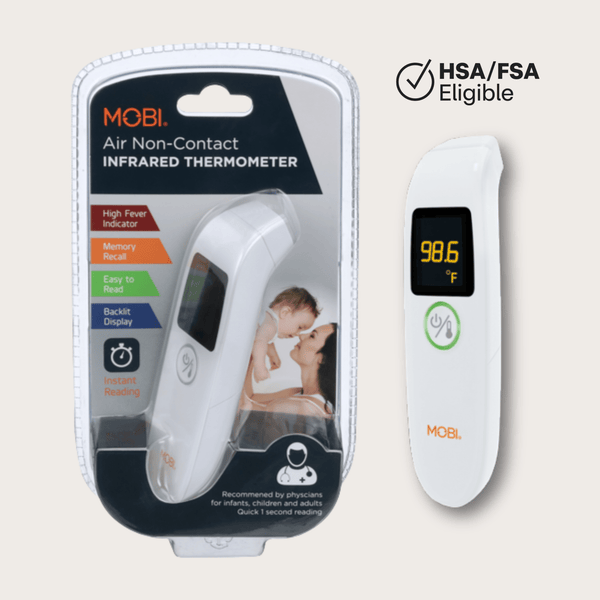
Air Non-Contact Digital Forehead Thermometer
$29.99
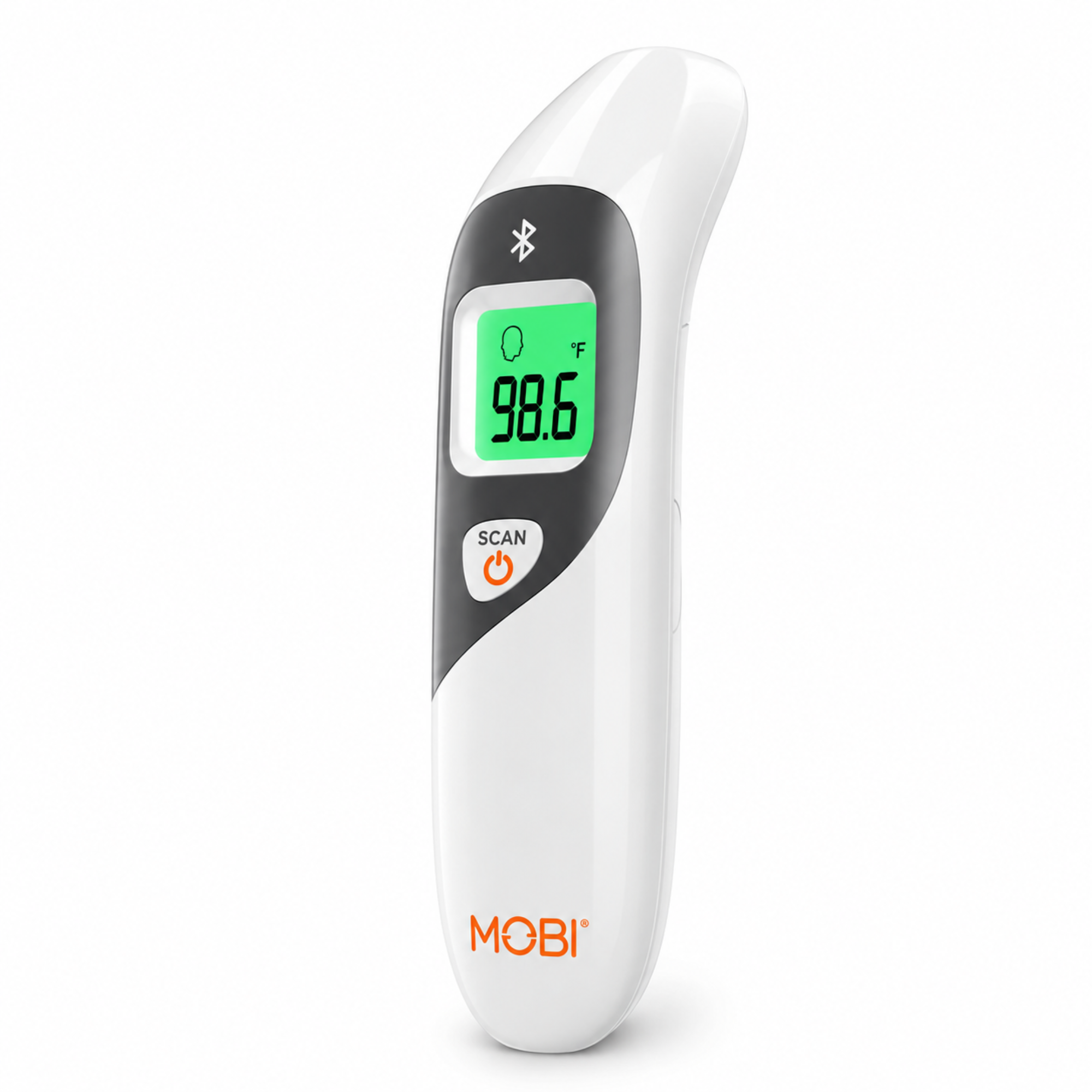
Digital Non-Contact Infrared Thermometer
$24.99
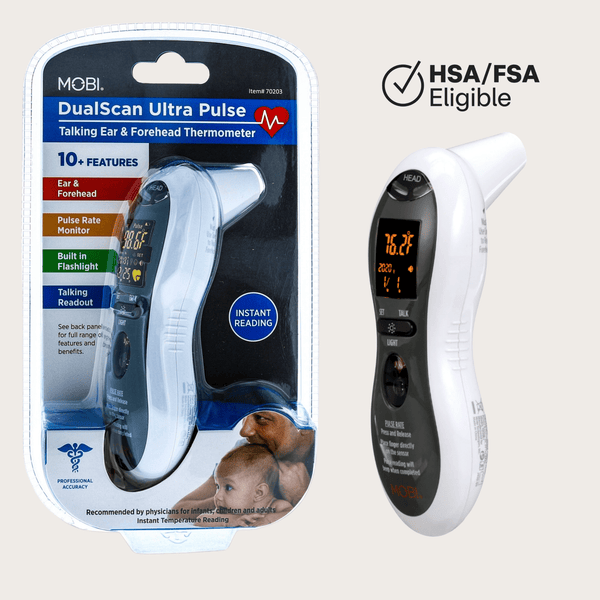
DualScan Ultra Pulse Ear & Forehead Talking Thermometer + Pulse Rate
$29.99
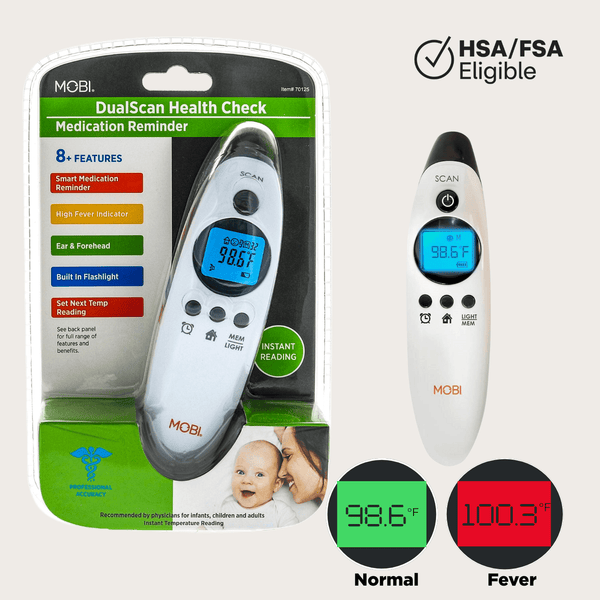
DualScan Health Check Ear & Forehead Thermometer + Medication Reminder
$24.99
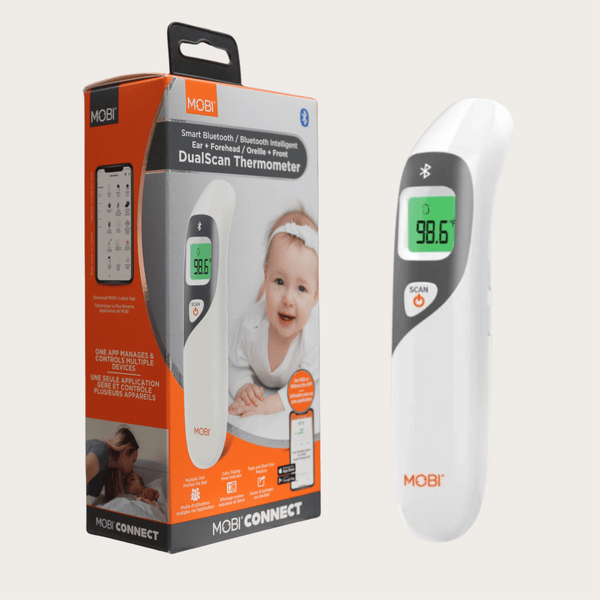
Smart Baby DualScan Ear & Forehead Bluetooth Thermometer
$29.99
Keep reading
Wrist vs. Upper Arm Blood Pressure Monitors: An Honest Comparison
A wrist cuff is easier to put on and an arm cuff is easier to trust. Here is how the two differ in real use, how to take a reading that counts, and who should pick which.
Read articleWhat Your Pulse Oximeter Reading Actually Means
A pulse oximeter gives you two numbers in eight seconds. Here is what SpO2 and pulse rate can tell you, what they cannot, and the three things that make a reading wrong.
Read articleThe Oral Thermometer Is Not Old-Fashioned. It Is Still the Baseline.
Under-the-tongue temperature is cheap, reliable and easy to repeat. Here is how to take an oral reading properly, and why a $5 thermometer still earns its place.
Read articleComparing models? See the full MOBI catalog side by side.
Compare products