Wrist vs. Upper Arm Blood Pressure Monitors: An Honest Comparison
A wrist cuff is easier to put on and an arm cuff is easier to trust. Here is how the two differ in real use, how to take a reading that counts, and who should pick which.
Blood pressure is one of the few things you can measure at home, in thirty seconds, that a doctor will actually act on. That makes the choice of monitor matter more than most $20 purchases. And it almost always comes down to the same question: wrist or upper arm?
We have sold both for years, and we talk to people who own both. The honest answer is not "one is accurate and the other is not." Both can produce numbers close to what you would get in a clinic. The difference is how much of the work the device does for you, and how much it leaves to your body position at that moment.
Why the upper arm cuff has the advantage
A cuff on the upper arm sits roughly at the level of your heart no matter how you are sitting, as long as your arm is on a table or armrest. That matters because blood pressure is a pressure relative to the heart. Raise your wrist above your heart and the reading drops. Let it hang below your heart and the reading rises. The same wrist can read ten points apart in the same minute depending on where the hand is resting.
An upper-arm cuff also wraps a large, stable limb. The artery sits close to the surface, the tissue does not shift, and the cuff has little room to rotate out of position. Cuff sizing is straightforward: measure around the middle of the upper arm and check the range printed on the cuff.
That combination is why clinical guidelines still describe upper-arm measurement as the reference method for home monitoring, and why a clinician who sees an unusual wrist reading will usually ask you to repeat it on the arm.
When a wrist monitor is the better device
This is where the comparison usually gets unfair. Wrist monitors are treated as the "lesser" option, but for a real group of people they are the only option that gets used consistently.
A wrist monitor is easier to put on by yourself if you have limited shoulder mobility, arthritis in the hands, or a large arm that falls outside a standard cuff range. It packs flat, which matters if you travel or split time between two homes. And because it goes on in five seconds, it is the monitor people actually reach for on a busy morning.
The monitor that gets used twice a day for a year beats the monitor that gets used for two weeks and then lives in a drawer.
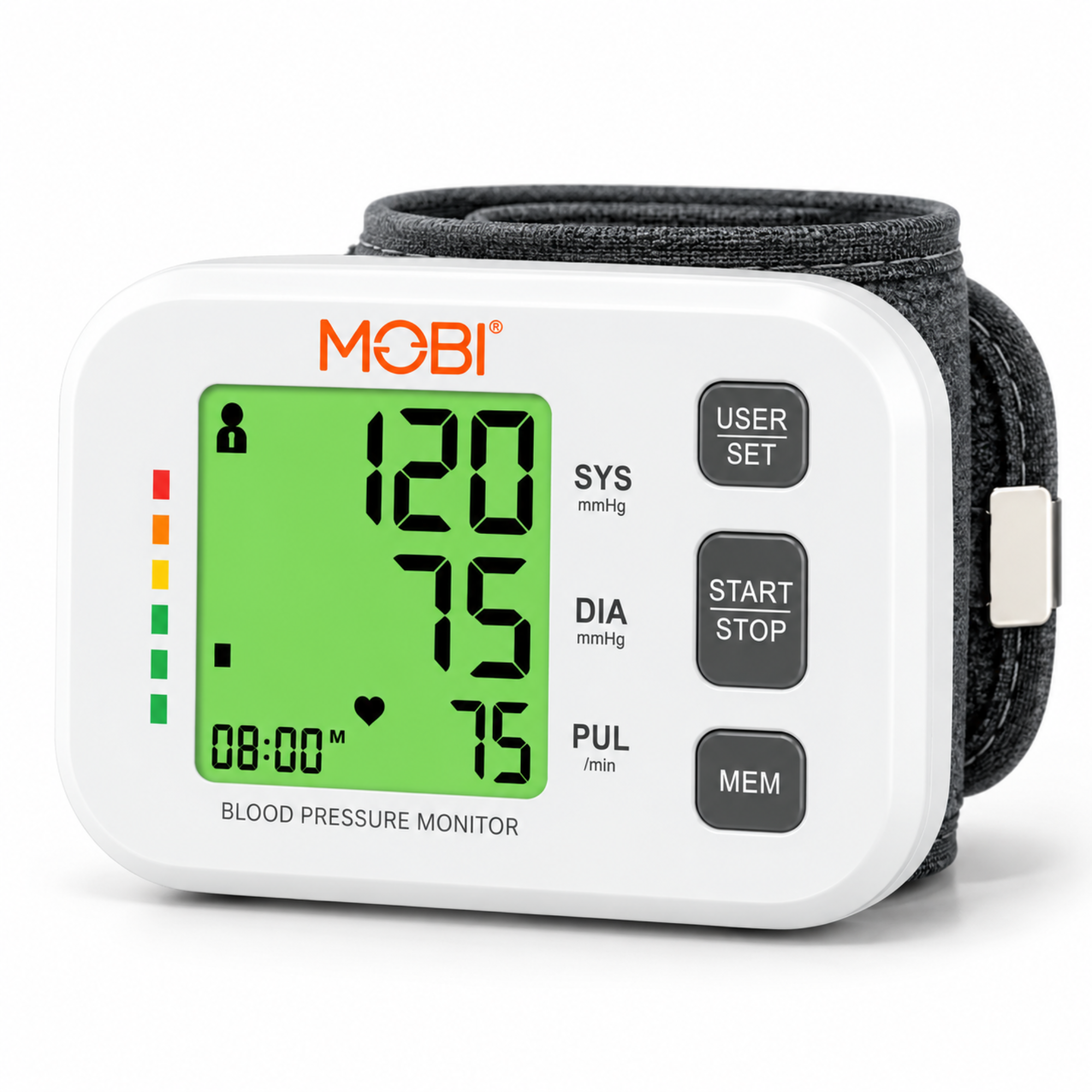
There is also a practical case for the wrist in two-person households. The MOBI wrist model stores readings in two separate memory sets, so a couple can share one device without mixing up whose numbers are whose.
The wrist technique that closes most of the gap
If you go with a wrist cuff, the device is only half the measurement. The other half is your posture, every single time.
- Rest the cuff on your chest, or on a table, so it sits at roughly the same height as your heart. Not higher, not lower.
- Keep your wrist relaxed. A clenched fist or a rigid forearm can push a reading up several points.
- Sit with your back supported and both feet flat on the floor. Crossing your legs is enough to shift the number.
- Wait five minutes after sitting down before the first reading, and avoid caffeine, exercise, and smoking for thirty minutes beforehand.
- Take two readings a minute apart and write down both, or let the device store them. One reading alone is a coin flip.
Do that consistently and a wrist cuff is a reasonable tracker. Skip it, and you will produce numbers that swing for reasons that have nothing to do with your blood pressure.
What the numbers actually mean
Home monitors show three numbers: systolic (the top), diastolic (the bottom), and pulse. The American Heart Association categories most clinicians use are:
- Normal: under 120 systolic and under 80 diastolic
- Elevated: 120 to 129 systolic, and under 80 diastolic
- Stage 1 hypertension: 130 to 139 systolic, or 80 to 89 diastolic
- Stage 2 hypertension: 140 or higher systolic, or 90 or higher diastolic
Read those as a pattern over a week, not as a verdict from a single morning. One high reading after a stressful call means very little. Five high readings across five days means something worth mentioning to your doctor.
Memory, apps, and the sharing question
A monitor without memory asks you to be the memory. That works until it does not, and it usually fails exactly when the information would be useful, like a two-week stretch before an appointment.
Store-and-recall on the device is the minimum. It lets you scroll back through recent readings and spot a trend without hunting for a notebook. Bluetooth syncing to an app goes a step further: readings land in a history you can show a clinician or share with a family member who is helping manage care.
Worth knowing before you buy: an app that only works while the phone is nearby is less useful than built-in memory. Battery-powered on-device storage keeps working on a trip, in a hotel, and after the app updates.
The mistake we see most often
People measure once, see a number they do not like, and measure again immediately, hoping it changes. It usually goes up. The cuff squeezes, the arm tenses, the anxiety rises, and the second reading is worse than the first.
If a reading looks off, wait a full minute, breathe out slowly, and take it again from a settled position. If it is still high, note it and move on with your day. That note, repeated over a week, is worth more than any single measurement.
Which MOBI model fits which person
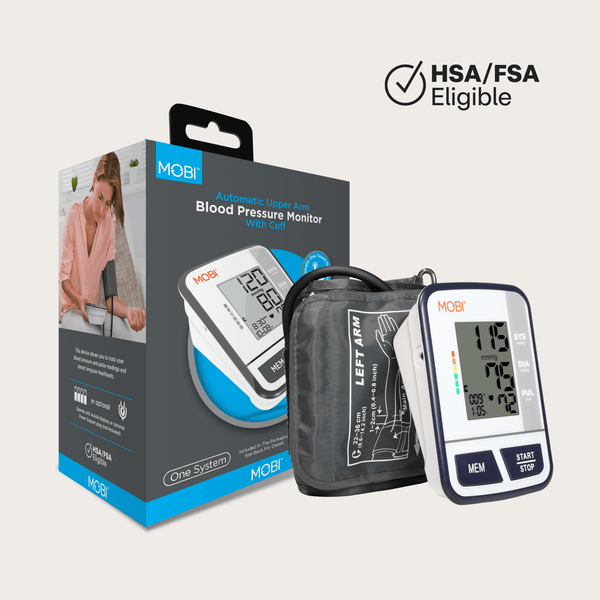
The Upper Arm Blood Pressure Monitor with Memory Recall is the straightforward reference device: a standard arm cuff, 120-reading memory, irregular heartbeat detection, and a large display, at the price of a dinner out. If you want one monitor for a household and no app involved, this is it.
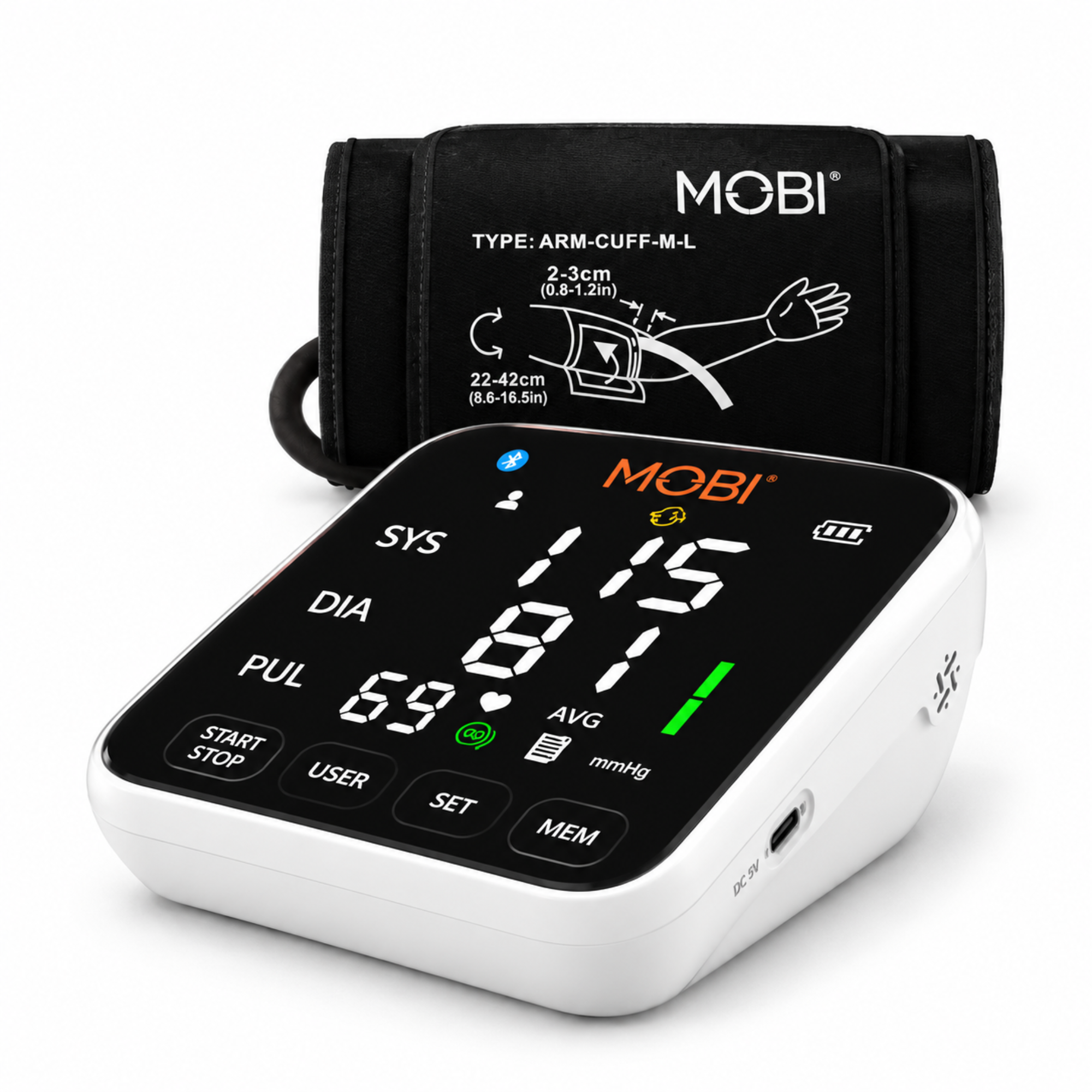
The Smart Bluetooth Arm Blood Pressure Monitor adds app sync, multi-user on-device memory, and a color-coded risk indicator, so readings land in a history you can hand to a doctor. It suits anyone tracking a diagnosed condition, or an adult child managing a parent's numbers remotely.
The Wrist Blood Pressure Monitor is the travel and small-space pick: backlit display, irregular heartbeat detection, two memory sets, and a fit range of 5.4 to 7.7 inches around the wrist. Take it on trips, keep it in a bag, or use it when an arm cuff is awkward to put on alone.
One last thing
Home monitoring is information, not a diagnosis. If you get a reading above 180 systolic or 120 diastolic, sit down, rest five minutes, measure again, and if it stays there, seek medical help rather than waiting for a pattern to develop. For everything else, the value is in the trend, and the trend is only as good as your routine.
This article is general information, not medical advice. Talk to your clinician about targets that fit your history.
Devices mentioned in this article
Keep reading
What Your Pulse Oximeter Reading Actually Means
A pulse oximeter gives you two numbers in eight seconds. Here is what SpO2 and pulse rate can tell you, what they cannot, and the three things that make a reading wrong.
Read articleEar vs. Forehead Thermometers: Which Reading Should You Trust?
Both take a temperature in a second. They do not measure the same place. A practical guide to picking a method by age, situation and time of night.
Read articleThe Oral Thermometer Is Not Old-Fashioned. It Is Still the Baseline.
Under-the-tongue temperature is cheap, reliable and easy to repeat. Here is how to take an oral reading properly, and why a $5 thermometer still earns its place.
Read articleComparing models? See the full MOBI catalog side by side.
Compare products