Looking in Your Child's Ear at Home: What You Can and Can't Tell
A phone-connected otoscope lets you see inside an ear. It does not let you diagnose an infection. How to use one well, and when a picture is actually useful.
There is a specific moment this device exists for. It is 8 p.m., a child is tugging at one ear and crying, and the question is whether this is a "give ibuprofen and see how the night goes" ear or a "call the on-call line" ear. A camera otoscope will not answer that question by itself. It can, however, change the phone call.
Here is what a home ear camera can do, what it cannot, and how to use one so the picture is worth looking at.
What you are looking at
An otoscope shines light down the ear canal and shows you the canal walls and, if you get the angle right, the tympanic membrane, the eardrum. That membrane is a thin, pearly, slightly translucent sheet stretched across the end of the canal.
A healthy eardrum looks pale, translucent, and slightly cone-shaped, pulled inward at the center. In an ear infection, the membrane typically looks bulging, cloudy or opaque, and red or yellow, and it does not move normally. In an ear with fluid but no infection, it can look dull or retracted.
Those distinctions are the entire point of a trained exam, and they are the reason a photograph is not a diagnosis.
What a home device can genuinely do
It gives you a baseline. If you look at your child's healthy ear once a month for a year, you know what normal looks like for them, and you can tell when something has changed.
It documents. A clear photo taken at 9 p.m. is useful at the appointment the next morning, when the ear may already look different. It also lets a second parent, or a grandparent watching the kids, see the same thing you see.
It supports a telehealth visit. Many pediatric telehealth services can work with a decent image plus symptoms. Some will not accept images at all, so check before relying on it.
It reduces unnecessary visits for the parent who is prone to worrying, and it reduces delay for the parent who is prone to waiting too long. Both of those are real benefits.
What it cannot do
It cannot tell you whether your child needs antibiotics. It cannot distinguish between the several conditions that look similar in a photo, including a red ear from crying, which is extremely common and resolves within minutes.
It also cannot see past wax. If the canal is plugged, you will see a brown wall and nothing else, and no amount of camera quality fixes that. Never use cotton swabs to clear a canal before an exam; you will push the wax further in.
A home otoscope turns a guess into a picture. A clinician turns a picture into a diagnosis.
Technique, which decides everything
- Have the child lie down with their head turned, or sit on an adult's lap with one arm held gently.
- In a child over a year, pull the ear gently up and back to straighten the canal. Under a year, pull it back and slightly down.
- Use the smallest speculum tip that fits comfortably. A tip that is too large will not enter, and forcing it hurts.
- Rest your hand against the child's head so the device moves with them rather than jabbing if they turn.
- Go slowly, in small movements. The canal curves; you are following it, not pushing through it.
- Look at both ears, always. Comparison is most of the information.
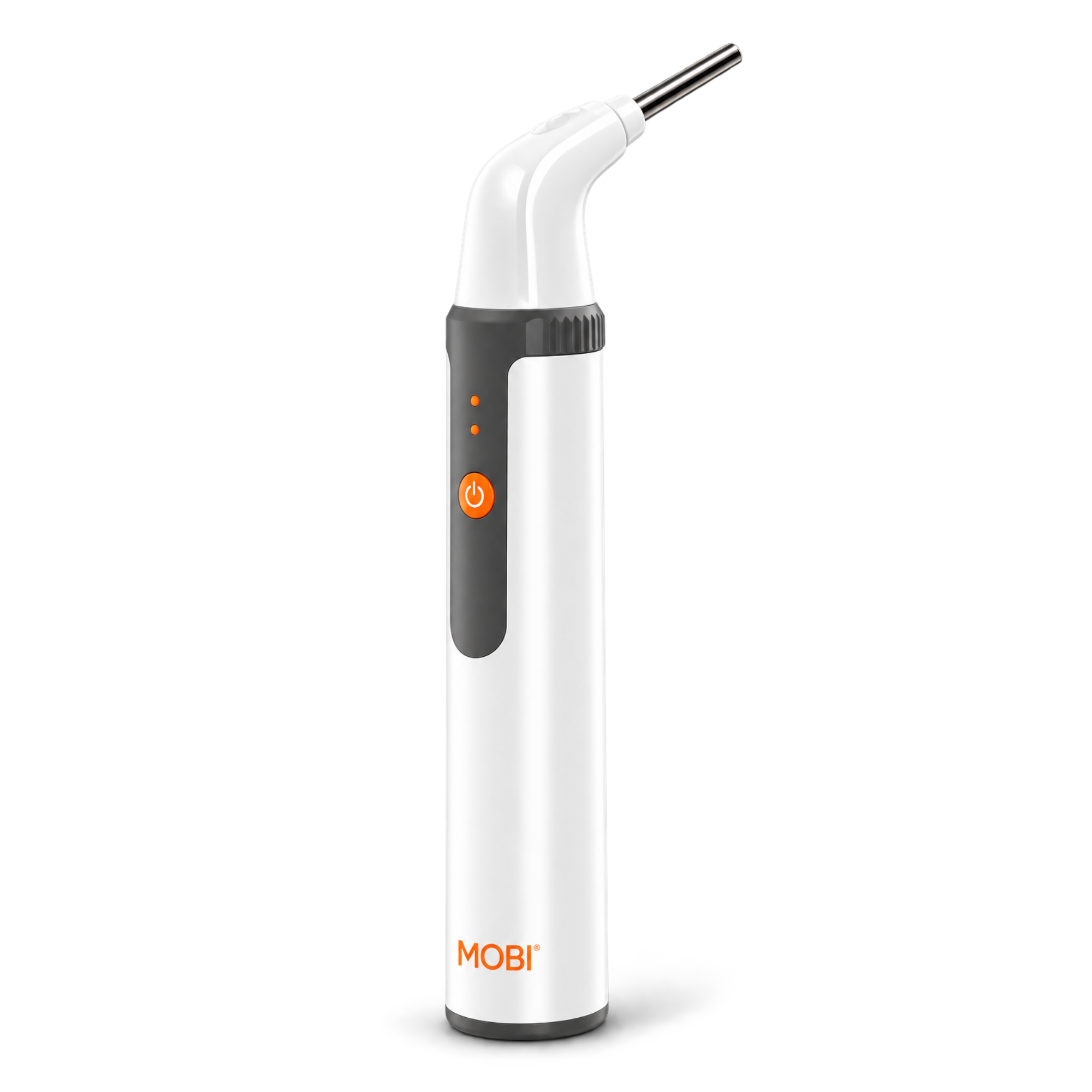
The MOBI Smart Otoscope Jr. streams a 1080P image to your phone, which makes the previous steps much easier to perform, because you are looking at a screen rather than squinting into an eyepiece while a child wriggles. Six LED lights handle illumination, a multi-axis gyroscope steadies the image as your hand moves, and the built-in battery runs over 90 minutes, which is many checks between charges.
Its second use is often the one people do not expect: nose and throat checks, which is why it ships with tips for both.
The symptoms that override the picture
No image changes these. Contact a clinician promptly if a child has:
- A fever with ear pain, especially under two years old
- Fluid, pus, or blood draining from the ear
- Sudden severe pain, or pain with swelling and redness behind the ear
- Hearing loss that persists after a cold
- Ear pain after inserting something into the ear
- An infant under three months with a fever of any kind
For an older child with mild pain, no fever, and a clear-looking eardrum, watching for a day is often reasonable, but that judgment belongs to you and your clinician, not to a camera.
Who actually gets value from one
Households with a child who has had repeated ear infections. Parents who travel or live far from a clinic. Families managing a child with ear tubes, where the doctor wants to know about discharge. Caregivers of an elderly parent with wax or irritation. Anyone who has ever driven to urgent care at 10 p.m. and been told the ear was fine.
If none of those describe you, a good flashlight and a thermometer will cover most evenings, and you can skip this purchase without guilt.
Keeping it clean and safe
Wipe the speculum tip with alcohol before and after each use, and use a fresh tip between family members. Never insert the device deeper than the point where you meet resistance. Never use it on a child who is thrashing; wait, or get help holding them. And store it out of reach, because a camera otoscope looks like a toy and will be treated as one.
This article is general information, not medical advice. Only a clinician can diagnose an ear infection.
Devices mentioned in this article
Keep reading
How to Clear a Baby's Stuffy Nose Without a Fight
Babies cannot blow their noses, and congestion at night is miserable for everyone. A calm, step-by-step routine using saline, suction, and timing that actually works.
Read articleNightlights and Baby Sleep: Choosing Light That Helps, Not Hurts
A little light makes night feeds possible and helps toddlers feel safe. Too much, or the wrong color, works against sleep. What the research and real routines suggest.
Read articleBuilding a Caregiver Alert Setup Your Parent Will Actually Wear
Medical alert systems fail for one reason: the button stays in a drawer. How to choose placement, who receives the alert, and what to test before you rely on it.
Read articleComparing models? See the full MOBI catalog side by side.
Compare products