How to Clear a Baby's Stuffy Nose Without a Fight
Babies cannot blow their noses, and congestion at night is miserable for everyone. A calm, step-by-step routine using saline, suction, and timing that actually works.
Newborns are obligate nose breathers for the first several months. They have not yet learned to switch to mouth breathing comfortably, which is why a small amount of congestion that would barely register in an adult can turn a baby's night into a series of wake-ups.
You cannot teach a baby to blow their nose. What you can do is build a short routine that clears enough airway for feeding and sleep, and that does not turn into a wrestling match nobody wins.
First, is it snot or is it swelling?
Congestion has two causes, and they need different handling.
Mucus congestion is mechanical: there is something in the nasal passage blocking airflow. You can hear it, you can often see it, and it responds to saline and suction.
Tissue swelling is inflammatory: the lining of the nose is puffy from a cold or allergy, and the passage is narrowed rather than plugged. Saline helps a little, suction does almost nothing, and time does most of the work. Dry air makes swelling feel worse, which is why a humidified room helps.
If a baby sounds congested but nothing comes out, you are probably dealing with swelling. Forcing repeated suction on a swollen nose irritates the tissue and adds crying, which adds more swelling.
Saline first, always
Suction alone pulls on dry, sticky mucus and mostly fails. Saline loosens it first.
Use a saline spray or drops made for infants, one to two drops or a short spray in each nostril. Wait thirty to sixty seconds. You will often hear the baby snuffle, swallow, or sneeze, and the mucus will start to move on its own. Sometimes that is enough, and you can skip suction entirely.
Do not use medicated nose drops or decongestant sprays in a baby without a clinician's guidance. Plain saline only.
Then suction, briefly
If the nose is still blocked after saline, suction for a few seconds per nostril. Not a minute, not until the nose is perfect. Short and effective beats long and traumatic.
Angle matters. Aim the tip toward the back of the head rather than straight up the nostril. A slight angle outward, along the floor of the nasal passage, gets behind the mucus instead of pressing into the wall.
With a manual bulb syringe, you squeeze before inserting, insert, release, and withdraw. With an automatic aspirator, the motor does the work while you hold the tip steady and the baby still.
Why adjustable suction changes the experience
Most nasal aspirators offer one level of suction: as much as the motor produces. That is fine for a toddler with a solid plug and overwhelming for a two-week-old with thin mucus. It is also why a lot of parents give up after two attempts.
An aspirator with five adjustable levels lets you start at the lowest setting, see how the baby tolerates it, and only increase if the mucus is genuinely stuck. Lower suction used successfully twice a day beats maximum suction used once and then refused.
A quiet motor matters for the same reason. A loud device next to a baby's ear triggers a startle reflex before you have even touched their nose.
The night-time light question
You will be doing this in the dark more often than in daylight. An overhead light wakes the baby fully, and a fully awake baby at 2 a.m. is a 90-minute problem.
A soft built-in light on the aspirator lets you see the tip and the nostril without illuminating the room. It sounds like a small thing until the third night of a cold, when it is the difference between a five-minute resettle and a full reset.
Timing that makes the routine work
- Before feeds, not after. A baby who can breathe through their nose feeds better, and a baby with a full stomach should not be tipped back for suction.
- Before sleep rather than in the middle of it, if you can.
- After a warm bath, when mucus is already loosened by the steam.
- Not more than a few times a day unless a clinician tells you otherwise. Over-suctioning irritates the lining.
What else actually helps
Humidity. A room between 30 and 50 percent relative humidity keeps mucus from drying into cement. A cool-mist humidifier or a purifier with a humidifier function helps, cleaned regularly.
Position. For sleep, babies should always be placed on their back on a firm, flat surface. Do not use pillows or wedges to elevate a baby's head; that is a suffocation risk, and no amount of congestion justifies it.
Fluids. For a baby over a few months, usual feeding frequency keeps mucus thinner. For a newborn, feed on demand as normal and watch wet diapers as your hydration signal.
When congestion needs a call, not a routine
Contact your pediatrician if a baby under three months has a fever, is breathing fast or with visible effort between the ribs, has nostrils that flare with each breath, is feeding noticeably less, has fewer wet diapers, or seems unusually sleepy or hard to wake. A blue tint around the lips is an emergency.
Congestion is normal. Breathing difficulty is not, and no device replaces an assessment.
Building the kit once
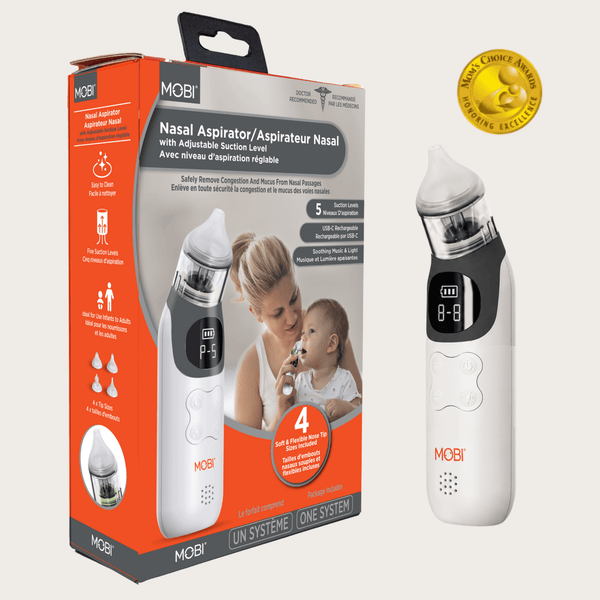
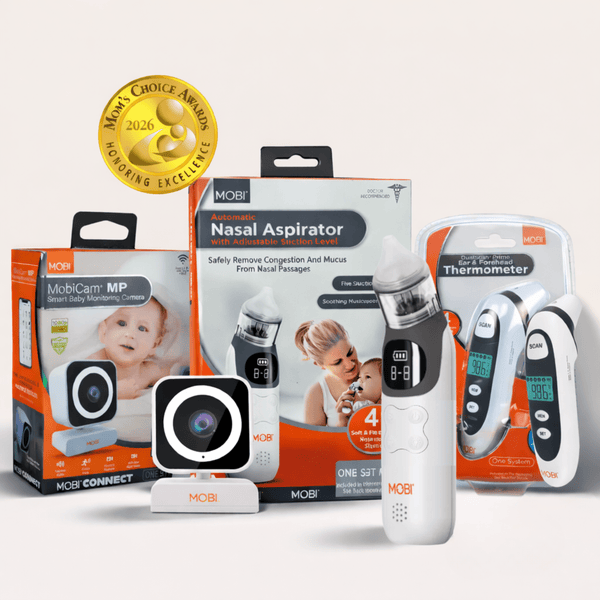
The MOBI Automatic Nasal Aspirator covers the hardware: five suction levels, a washable silicone tip, a quiet motor, one-button operation, and a night light for dark rooms. The Baby Care Essentials Bundle pairs it with a baby thermometer and a smart monitor, which is the practical answer to the first winter: congestion, fever, and check-ins are the three things you will need in the same week, and buying them together costs less than buying them separately.
Keep the aspirator with the thermometer, not in a drawer in another room. The kit that lives together gets used.
This article is general information, not medical advice. Follow your pediatrician's guidance for your child, especially in the first three months.
Devices mentioned in this article

Keep reading
Looking in Your Child's Ear at Home: What You Can and Can't Tell
A phone-connected otoscope lets you see inside an ear. It does not let you diagnose an infection. How to use one well, and when a picture is actually useful.
Read articleNightlights and Baby Sleep: Choosing Light That Helps, Not Hurts
A little light makes night feeds possible and helps toddlers feel safe. Too much, or the wrong color, works against sleep. What the research and real routines suggest.
Read articleBuilding a Caregiver Alert Setup Your Parent Will Actually Wear
Medical alert systems fail for one reason: the button stays in a drawer. How to choose placement, who receives the alert, and what to test before you rely on it.
Read articleComparing models? See the full MOBI catalog side by side.
Compare products