The Oral Thermometer Is Not Old-Fashioned. It Is Still the Baseline.
Under-the-tongue temperature is cheap, reliable and easy to repeat. Here is how to take an oral reading properly, and why a $5 thermometer still earns its place.
Every few years the thermometer category reinvents itself: infrared, no-touch, Bluetooth, app-connected. All of it is genuinely useful. And yet the small digital thermometer in the bathroom drawer, the one that costs less than a sandwich, still measures temperature accurately enough for a household decision.
There is a reason emergency kits, school nurses' offices, and travel toiletry bags all contain the same thing.
Why oral works
The mouth sits under the tongue in a pocket of tissue with a generous blood supply, close to the body's core. A probe resting there for thirty to sixty seconds reaches thermal equilibrium with that tissue, which makes the reading a reasonable stand-in for core temperature.
It is also the most repeatable method. The same spot, the same timing, the same device. That consistency is worth more than a fraction of a degree of theoretical precision, because what you are really watching is change over hours.
An oral thermometer is also the cheapest way to have one per family member, which quietly solves the hygiene question.
The technique, in order
- Wait fifteen to thirty minutes after anything hot or cold: coffee, ice water, a cigarette, chewing gum.
- Make sure the tip is clean, and use a fresh probe cover if your model takes one.
- Place the tip under the tongue, to one side of the center, and close your lips around it. Breathe through your nose.
- Keep it there for the full time the device asks for. Do not pull it out early to check.
- Hold still and do not talk. Talking moves the probe and lets cooler air in.
- Note the number and the time.
The most common error is holding the thermometer between the lips rather than under the tongue. That reads the outside of the mouth, which runs cooler, and produces a falsely low number.
Covers, cleaning, and sharing
A digital oral thermometer is a device you put in your mouth, so the hygiene part is not optional. A fresh cover per person per use handles it. Where covers are not available, wash the probe with soap and cool water and wipe it with alcohol, then let it dry completely before the next use.
This is the practical argument for owning two: one for adults, one for kids, and no negotiation at 2 a.m. about who used it last.
Where oral hits its limits
Oral readings need cooperation. A toddler who will not keep their mouth closed, a person who is congested and breathing through their mouth, someone recovering from oral surgery, or anyone who is confused or unresponsive is not a candidate.
Mouth breathing is the sneaky one. If someone has a blocked nose and has been breathing through their mouth for an hour, the mouth is cooler than core, and the reading will be low even with a fever.
For infants, an oral reading is not practical at all, which is where pacifier-style thermometers come in.
The pacifier thermometer, honestly assessed
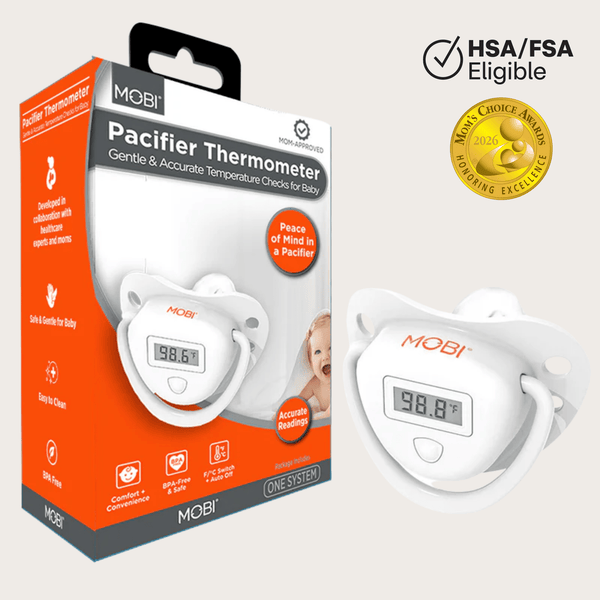
A pacifier thermometer takes an oral reading while giving a baby something familiar to suck on. It is genuinely clever: the measurement happens during something the baby already wants to do, so there is no restraint, no struggle, no escalating crying.
The trade-offs are the ones you would expect. It takes longer than infrared, roughly a minute and a half, and it only works while the baby keeps it in their mouth. It also needs the same hygiene routine as any oral device.
For a fussy infant at home, especially one who is already using a pacifier, it converts a fight into a routine. For a sleeping baby, a forehead reading is faster. Many parents end up with both, and use whichever fits the moment.
Reading the number
A normal oral temperature is generally cited as around 98.6°F (37°C), though normal varies by person and by time of day. Most people run cooler in the early morning and warmer in late afternoon and evening. A single reading of 99.1°F is not necessarily a fever for someone whose baseline is 98.9°F.
The commonly used fever threshold for an oral reading is 100.4°F (38°C) and above. Below that, watch for pattern and behavior. Above it, and especially with other symptoms, treat it as information worth acting on.
Note the method when you record a temperature. An oral reading and an ear reading on the same person can differ by up to a degree, and a clinician will want to know which one you used.
Why the cheap one keeps earning its place
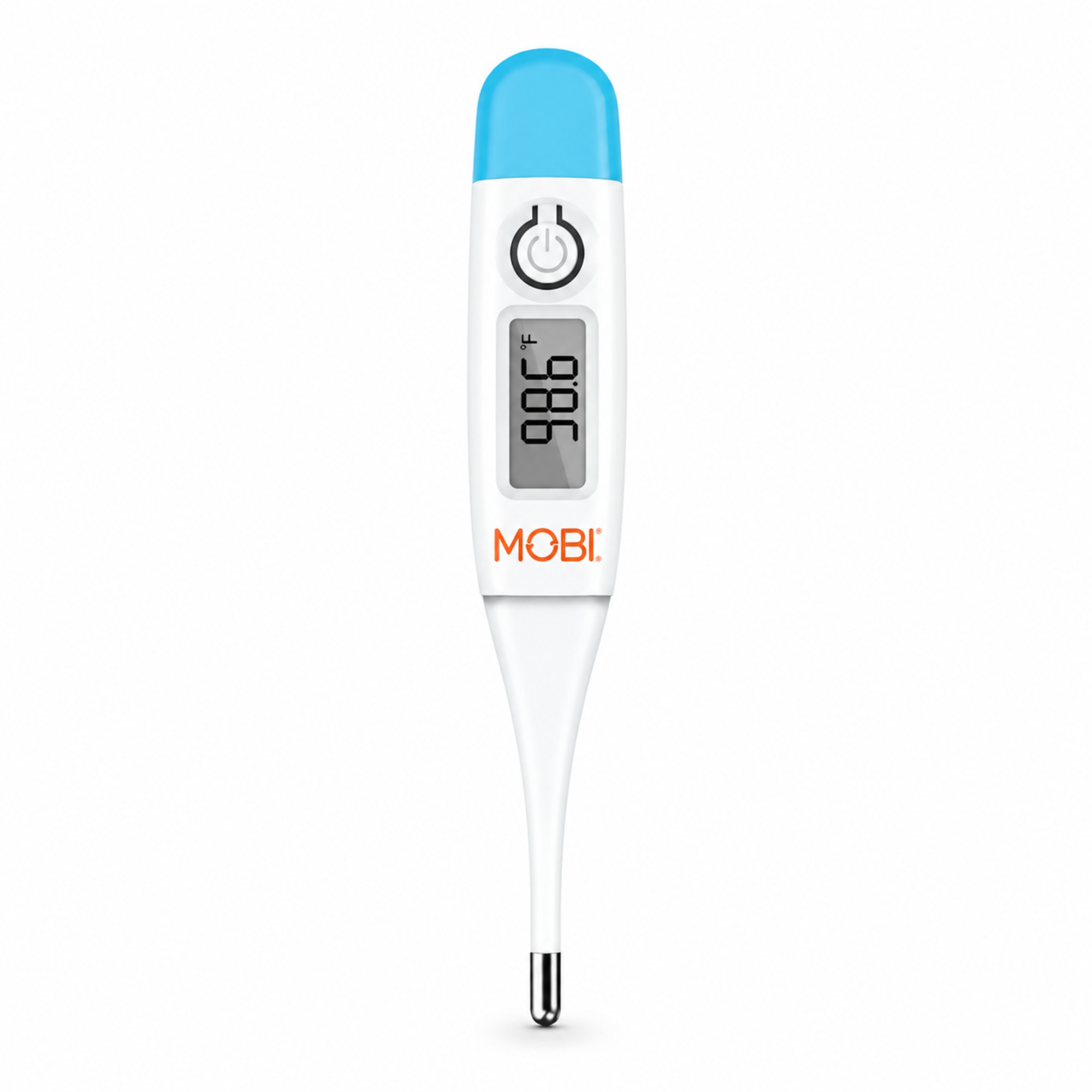
The MOBI Digital Oral Thermometer with Hygienic Cover costs about as little as a thermometer can and does the job without ceremony: a flexible tip that is comfortable under the tongue, a reading in under a minute, a beep when it is done, memory of the last reading, and a waterproof tip that is easy to clean. It ships with protective covers.
There is no app, no Bluetooth, no color display. There is also no firmware to update, no pairing to fail, and no battery anxiety beyond a standard coin cell. In a travel kit or a first-aid box, that simplicity is the feature.
Where it fits in a household
Our honest recommendation, after years of watching how people actually use these devices: keep one accurate digital thermometer per person in a drawer, and add a fast infrared device for the situations where cooperation is not available. The oral thermometer is the one you trust when you have time. The infrared one is the one you use when you do not.
This article is general information, not medical advice. Contact a clinician for fevers in infants under three months, fevers that last more than a few days, or any fever with severe symptoms.
Devices mentioned in this article
Keep reading
Wrist vs. Upper Arm Blood Pressure Monitors: An Honest Comparison
A wrist cuff is easier to put on and an arm cuff is easier to trust. Here is how the two differ in real use, how to take a reading that counts, and who should pick which.
Read articleWhat Your Pulse Oximeter Reading Actually Means
A pulse oximeter gives you two numbers in eight seconds. Here is what SpO2 and pulse rate can tell you, what they cannot, and the three things that make a reading wrong.
Read articleEar vs. Forehead Thermometers: Which Reading Should You Trust?
Both take a temperature in a second. They do not measure the same place. A practical guide to picking a method by age, situation and time of night.
Read articleComparing models? See the full MOBI catalog side by side.
Compare products