Your Smart Scale's Body Fat Number Is Not What You Think It Is
Body composition scales are useful tools that are widely misread. What the 18 measurements actually mean, how to use them well, and which changes are real.
A body composition scale is one of the more interesting devices you can put in a bathroom. Step on it, and instead of one number you get eighteen: weight, BMI, body fat percentage, muscle mass, bone mass, water percentage, visceral fat, metabolic age, and a handful more.
Then the numbers move in ways that seem impossible, and people reasonably conclude the scale is broken. It usually is not. It is doing something more specific than most people expect.
How the scale gets those numbers
The technology is called bioelectrical impedance analysis, or BIA. A very small, imperceptible current passes from one foot to the other, and the scale measures how much resistance it meets. Muscle and water conduct electricity well. Fat resists it. From that resistance, plus your height, weight, age and sex, the scale estimates how much of you is fat and how much is lean tissue.
That last sentence is the important one. The scale directly measures one thing: resistance. Everything else is a calculation built on population averages.
So body fat percentage from a foot-to-foot scale is an estimate, not a measurement. It tends to be reasonably consistent for a given person in consistent conditions, which is exactly what makes it useful for tracking. It is not accurate enough to compare yourself against a friend, or against a number from a different brand of scale.
Why hydration moves the needle more than fat does
Water conducts the current. If you are dehydrated, resistance goes up and the scale reads your body fat higher. Drink a liter of water and the same body reads lower. A hard workout, a salty meal, a hot day, or a night of poor sleep can shift the number by a percentage point or two without any change in actual body composition.
This is why the scale can tell you that you gained 1.2 percent body fat overnight. You did not. You were dehydrated when you woke up.
A body composition scale is a trend tool, not a truth machine. Treat each reading as one sample, not a verdict.
How to get numbers worth comparing
The whole value of a body composition scale comes from standardizing the conditions. Pick a routine and keep it.
- Weigh yourself first thing in the morning, after using the bathroom, before eating or drinking.
- Wear the same thing, or nothing, every time.
- Stand barefoot on the metal contacts. Socks break the circuit.
- Keep the scale on a hard, flat floor. Carpet absorbs the reading.
- Compare weekly averages, not daily readings.
- Give a change three weeks before believing it is real.
Do that and the trend line becomes genuinely informative: a slow decline in fat percentage with stable muscle mass is a real signal. Do it randomly, at different times of day, and you are reading noise.
BMI is on the screen, and it is limited
BMI is a ratio of weight to height. It says nothing about body composition, and it treats a muscular 5'10" person and an inactive person of the same height and weight identically. It is on the scale because it is a widely used screening number, and it is worth knowing, but it is the least personal figure in the list.
If your BMI reads "overweight" while your body fat and muscle numbers look healthy, the BMI is the number that is least useful to you.
Which of the 18 are worth watching
Most people get the most value from four:
- Weight, as a 7-day average
- Body fat percentage, as a slow trend
- Muscle mass, to make sure you are not losing it while losing weight
- Visceral fat, which is the fat around the organs and is more closely tied to health risk than total body fat
Bone mass and metabolic age are estimates derived from the others. They are interesting once, and then they rarely change. Water percentage is mostly a hydration readout and is best treated as a check on whether today's reading is comparable to yesterday's.
The multi-user question
A smart scale that logs to an app needs to know who is standing on it. Good implementations recognize a person by their weight history and assign the reading to the right profile. In a household of three adults, that matters: mixed-up profiles make everyone's trend line useless.
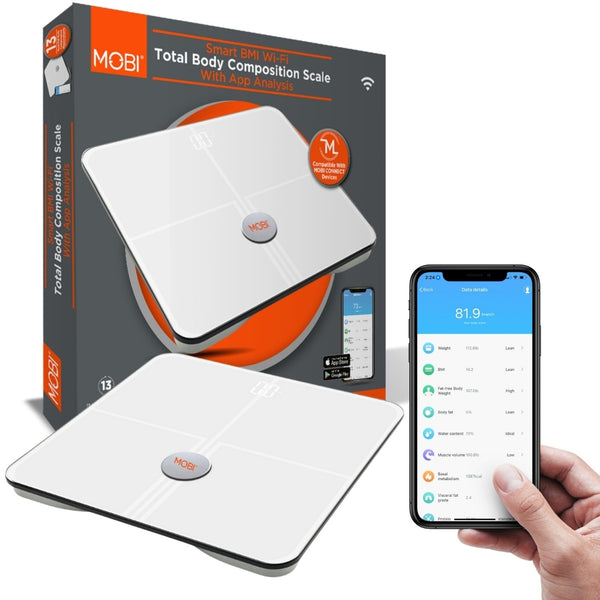
The MOBI smart scale handles this with separate profiles, and syncs over Wi-Fi rather than Bluetooth, which means you do not have to have your phone in the bathroom or open an app. You step on, the reading uploads, and the history builds itself. For a device used every morning at 6:40 a.m., removing that one step is the difference between a chart with 300 entries and a chart with 11.
What the scale cannot do
It cannot tell you whether you lost fat or muscle from a single reading. It cannot measure body fat precisely enough to compare with a lab method like DEXA. It cannot detect a health problem, and it is not a diagnostic tool.
What it can do is show you, over months, whether the direction of travel matches your intent. That is a modest promise, and it is exactly the promise the device keeps.
This article is general information, not medical advice. Talk to a clinician or dietitian about body composition goals that fit your health history.
Devices mentioned in this article
Keep reading
Wrist vs. Upper Arm Blood Pressure Monitors: An Honest Comparison
A wrist cuff is easier to put on and an arm cuff is easier to trust. Here is how the two differ in real use, how to take a reading that counts, and who should pick which.
Read articleWhat Your Pulse Oximeter Reading Actually Means
A pulse oximeter gives you two numbers in eight seconds. Here is what SpO2 and pulse rate can tell you, what they cannot, and the three things that make a reading wrong.
Read articleEar vs. Forehead Thermometers: Which Reading Should You Trust?
Both take a temperature in a second. They do not measure the same place. A practical guide to picking a method by age, situation and time of night.
Read articleComparing models? See the full MOBI catalog side by side.
Compare products